overview
We started by redesigning how real estate agents work.
Afair began as a real estate management platform for agents and agencies — bringing properties, leads, transactions, communication and performance into one central workspace.
The initial problem looked operational:
agents were constantly moving between CRMs, spreadsheets, WhatsApp, calendars, listing platforms and reporting tools.
But as we mapped that workflow more closely, something bigger became visible.
Fragmentation wasn't only happening inside the agency.
It existed across the entire property journey.

product problem
The first problem was fragmentation.
Real estate agents had plenty of software. The problem was that none of it felt like one system. A customer conversation might happen in WhatsApp. Property information lived somewhere else. Follow-ups went into a calendar. Pipeline information sat inside a CRM. Performance lived inside another dashboard. Each tool solved a task.
Together, they created friction.

product thesis
What if the agent didn't have to rebuild context every time they changed tasks?
Afair became a single operational workspace connecting:
properties
leads
transactions
communication
performance
The goal wasn't simply to consolidate software.
It was to create continuity between the information agents had and the work they needed to do next. Afair's published project describes this same move from fragmented tools toward a centralized workflow and clearer pipeline visibility.

product idea
Instead of designing every feature as an isolated destination, I approached Afair as a connected product system.
A property could belong to a lead.
A lead could progress into a transaction.
Communication could remain attached to that journey.
And activity across the platform could build a clearer picture of business performance.
The dashboard became less about showing more information —
and more about removing the need to look elsewhere.

Agents needed to move quickly between dense information: clients, listings, transactions, messages, performance and ongoing tasks.
Real estate platforms can contain a huge amount of information. The goal wasn't to remove that complexity. It was to organise it so that the most important information remained easy to scan, compare and act on throughout the day. I designed a structured dashboard system around clear hierarchy, reusable patterns and predictable interactions, allowing dense operational information to remain manageable.


product exploration
Then the research changed the scope of the problem.
While mapping the agent journey, we kept encountering important decisions that happened before Afair became useful.
Two questions stood out.
Is this person actually ready to buy?
and
What property is genuinely right for them?
Neither was fundamentally a CRM problem. But both affected everything that eventually entered the CRM.
That gave us two adjacent product hypotheses worth exploring.

that is not all
Afair started as a product. The research revealed a product ecosystem, and AI changed the economics of exploration.
Designing Afair exposed something interesting. The real estate journey wasn't fragmented only inside the agency. Fragmentation existed across the entire experience, from understanding a buyer, to finding the right property, to deciding whether buying was the right decision in the first place. So I kept exploring the problem space.
Traditionally, exploring two adjacent product opportunities would mean weeks of specification, design and engineering before users could experience anything meaningful.
Instead, we used AI-assisted product development to compress the distance between:
hypothesis → prototype → feedback → iteration
For Soma and Nore, the stack expanded beyond Figma into Claude, Cursor and Vercel, allowing ideas to move beyond static mockups and become interactive products that could be evaluated much earlier. Both projects currently list Claude, Cursor, Vercel and Figma as their core tools.

From one product to three.
Afair: Run the real estate business.
A central workspace connecting properties, leads, transactions, communication and performance, reducing the operational fragmentation agents faced every day.
properties → leads → transactions → performance

From one product to three.
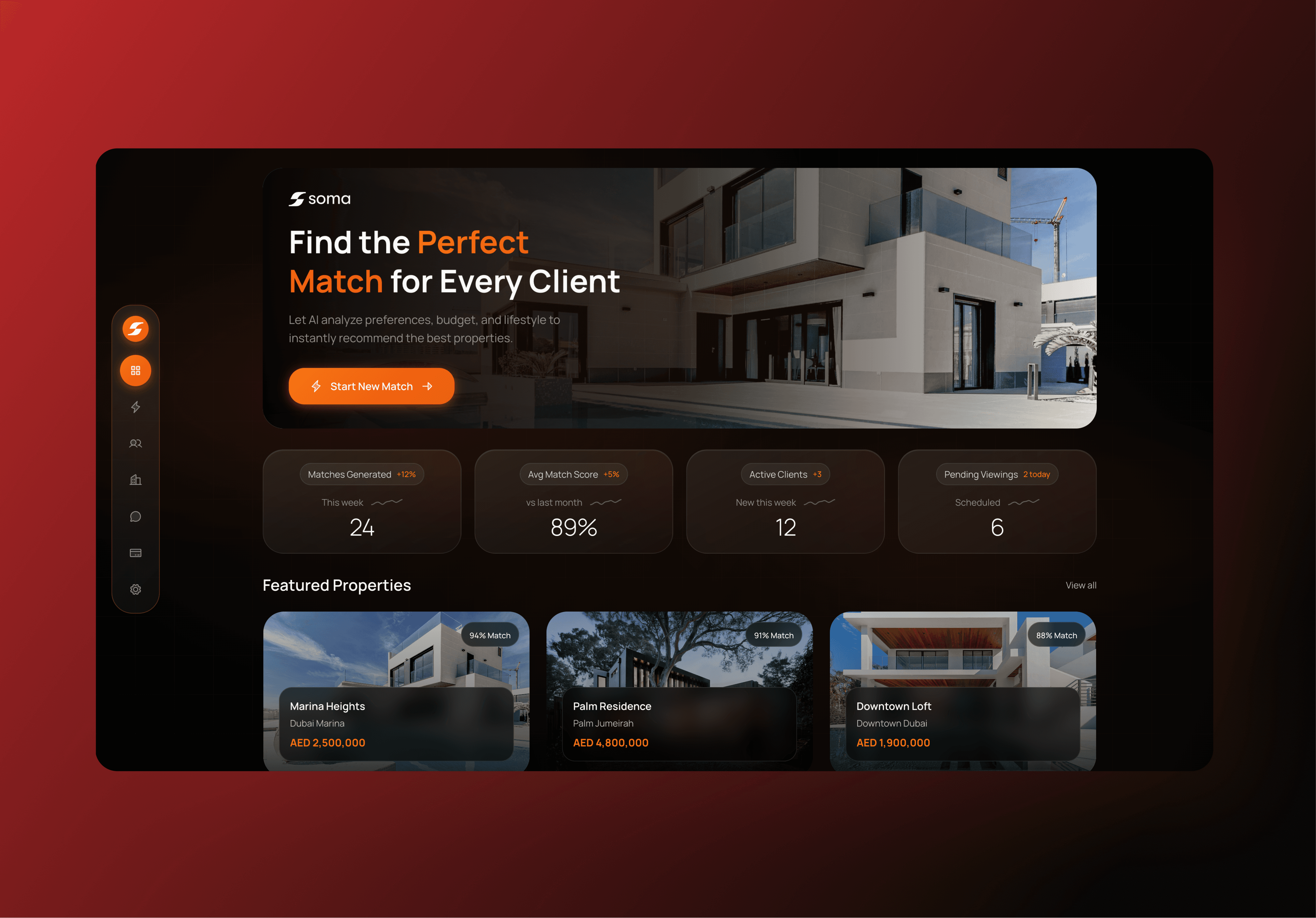
Soma: Property search understood the house. It didn't always understand the person.
The next problem appeared between readiness and transaction. Instead of matching buyers through surface-level filters alone, I designed an AI-powered experience that considered financial readiness, lifestyle, preferences and long-term goals to create more meaningful property matches.
person → needs → compatibility → property


From one product to three.
nore: Affordability isn't the same as readiness. Is buying actually the right decision for me?
Nore moved even further upstream. Rather than asking only “Can I afford this?”, the product combined financial information with flexibility, stress tolerance, lifestyle goals and long-term priorities to help people understand whether home ownership actually fit their lives.
life → finances → scenarios → decision


Same industry. Different moments of the journey. Afair became the starting point for a broader exploration of real estate.
Nore explored readiness.
Soma explored matching.
Afair explored operations.
Together, they looked at the same industry from three different perspectives:
deciding → finding → managing
product opportunity.
The product opportunity wasn't just shared features. It was shared context.
Instead of repeatedly asking users to start from zero, information could progressively become more valuable as they moved through the journey.
Nore
Who are you and what can your life support?
↓
Soma
What properties fit that context?
↓
Afair
How do we turn that opportunity into a managed relationship and transaction?
This would be a future-state ecosystem vision, rather than something I would present as already shipped.
What changed in our product thinking
We stopped thinking in features.
The initial question was how to build a better real estate workspace. The more useful question became:
Where does uncertainty exist across the entire journey?
We explored problems before committing to products.
Nore and Soma started as hypotheses, not roadmap commitments.
Rapid AI prototyping gave us a way to make those hypotheses tangible enough to challenge.
We looked for shared context.
The strongest connection between the products wasn't visual consistency.
It was data and understanding that could become progressively richer from one moment of the journey to another.
We used AI to accelerate learning, not just delivery.
Shipping faster is useful. Learning that something shouldn't be shipped at all can be even more valuable.
operational impact
35–45%
estimated reduction in daily administrative time. Afair reduced the effort required to reconstruct information across disconnected systems.
Matching impact
60%
estimated reduction in property shortlisting time
strategic impact
3 testable products
One initial product became three testable product hypotheses across the same customer journey.
Research around Afair expanded the opportunity from agency operations into buyer readiness and property matching, while rapid AI prototyping created a lower-cost way to test those directions before committing to full-scale development.
What I learned
Follow the problem beyond the product boundary.
Some of the most valuable opportunities appeared outside the scope of the original CRM.
Prototype uncertainty.
The less certain we were about an idea, the more useful it became to make that idea tangible early.
AI changes what is economically worth exploring.
When functional prototypes become faster to create, teams can test more ambitious product hypotheses without treating every experiment as a major engineering commitment.