overview
Financial agents didn't have an information problem. They had an operational clarity problem.
The existing workflow was spread across paper notes, Airtable, manual reminders and disconnected tools. Customer information existed but understanding what needed attention, what was overdue and what to do next required constant manual effort. GestFinance was designed to turn that fragmented workflow into a single operational platform. Not another place to store customer data. A system for acting on it.
product problem
The problem wasn't where information lived. It was knowing when information became actionable.
During discovery, I mapped the agent workflow to understand how information moved from a conversation into an actual task. Rather than focusing only on where data was stored, I looked at the moments where information needed to trigger something: a call, a meeting, a reminder, a deadline, a follow-up. That distinction became the foundation of the product.
The product thesis
A CRM should not only collect information. It should help an agent understand the next best action, the right timing and the right priority.
Traditional CRMs are good at answering: Who is this client? What information do we have? But an agent's working day is driven by different questions: Who needs my attention today? What am I waiting for? What is becoming urgent? What should happen next?That shifted the design direction from a passive system of record toward an operational assistant. This principle shaped the information architecture, activity model, notification logic, mobile experience and AI Agent.
product solution
One place for the entire client relationship.
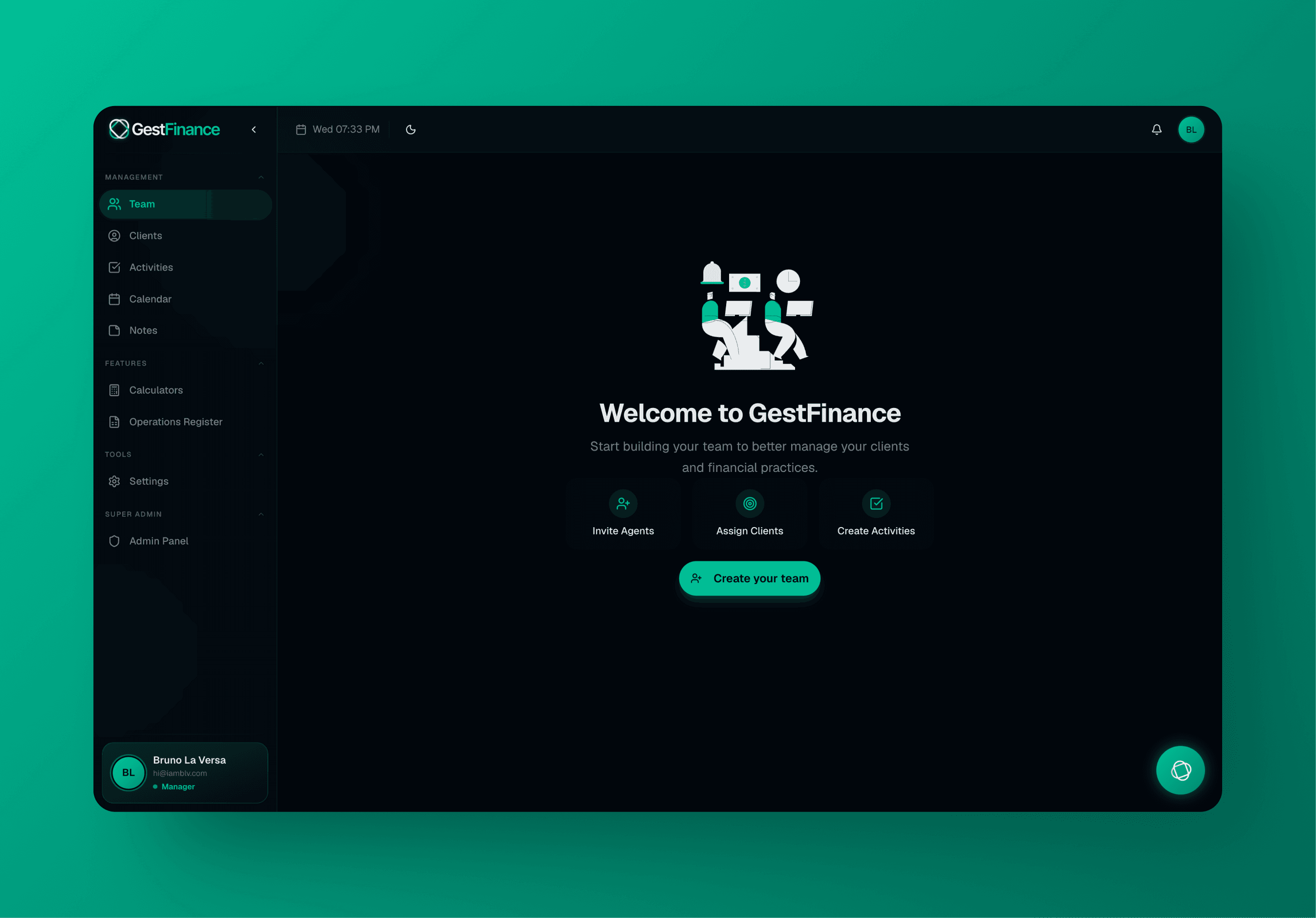
Instead of spreading context across several tools, GestFinance brought the core workflow together: Leads & clients, Practices & documents, Activities & calendar, Notes & interaction history, Team & network management. But consolidating information wasn't enough. The system still needed a mechanism that connected customer context with daily work.

Activities became that mechanism. Every client needed to become actionable. Activities became the bridge between customer information and execution.
From the client record, an agent could create: Calls, Meetings, Follow-ups, Deadlines, Reminders. Instead of remembering that something needed to happen after reading a note, the action became part of the customer record itself.

From memory-based work to system-assisted work
from: Client conversation → Paper note → Remember to follow up → Manually check calendar → Hopefully do it on time→
to: Client conversation Structured context → Create activity → Priority + timing → Follow-up becomes visible

Then we added intelligence. AI wasn't a separate destination. It was a shortcut to operational clarity.
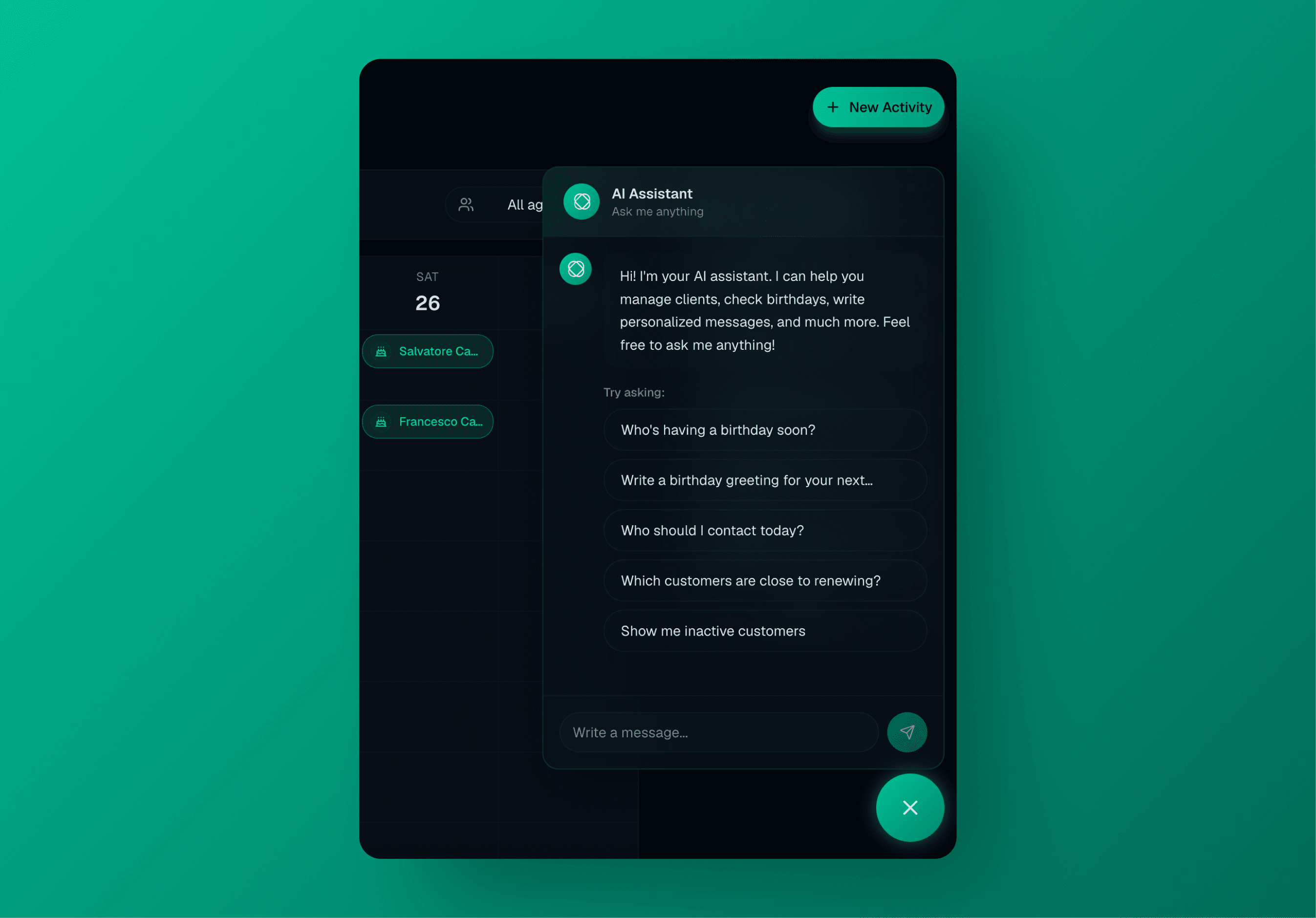
The AI Agent lived inside the workflow and helped agents interrogate the information already available in the system. Instead of asking generic questions, agents could ask things such as:
Which clients should I call today?
Which deadlines are approaching?
Which practices are most urgent?
Which follow-ups are overdue?
AI accelerated the product design process too.
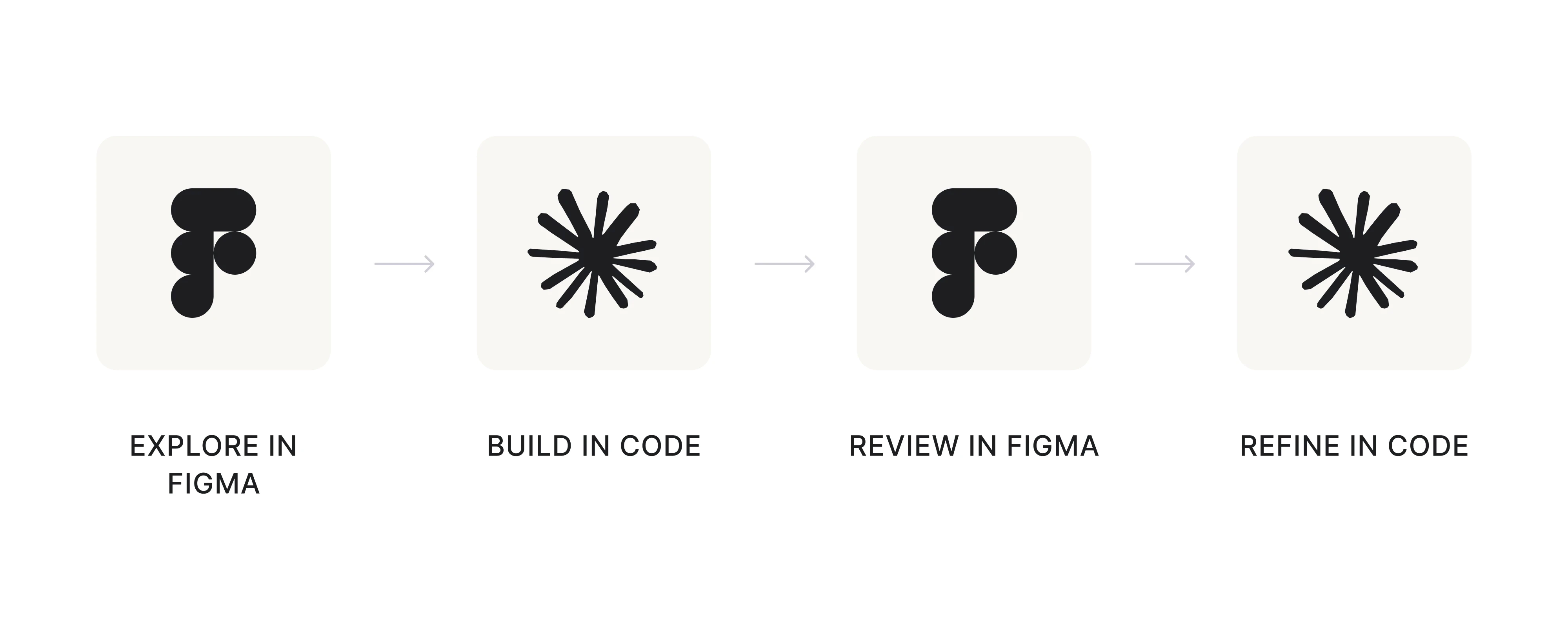
GestFinance was also the first project where I incorporated AI deeply into my own product design workflow. I used it across: Research synthesis, Workflow mapping, Information architecture exploration, Early wireframes, Rapid prototyping
But AI wasn't used to replace product thinking.
It helped reduce the distance between an assumption and something we could inspect, prototype and discuss.
design system
A complex financial product needed a simple visual system.
As the platform expanded across clients, activities, practices, documents and AI interactions, consistency became part of the usability problem. I created a shared design language covering: colour, states, cards, navigation, interaction patterns, AI surfaces. The goal was to make a data-heavy environment feel predictable without making it feel heavy.

Product impact
GestFinance created a unified operational platform.
80%
productivity increase observed in small internal tests.
Less effort
Reduced time spent finding and reconstructing context.
More visibility
A clearer overview of clients, practices and activities.
60%
of beta users created more than one asset
45%
reused previously generated assets in new workflows
What I learned
The value wasn't just a faster CRM. It was turning operational knowledge into reusable product infrastructure.
Model the action, not just the data.
A CRM becomes useful when its information can drive behaviour. Designing activities as first-class objects was more important than simply creating richer client profiles.
Operational clarity beats feature density.
The hardest part wasn't adding capabilities. It was making it obvious what deserved attention and what should happen next.
AI works best when it already understands the context.
Embedding intelligence inside an existing workflow created more value than treating AI as an isolated destination.
AI can shorten the path between thinking and testing.
Using AI throughout research synthesis, IA exploration and prototyping allowed ideas to become tangible much earlier — while product judgement remained human.