overview
lightful had spent more than a decade helping nonprofits communicate better. the challenge was making that expertise scale.
lightful supports nonprofit organisations through learning programmes, digital tools and coaching — helping them build trust, raise awareness and ultimately increase funding. but much of the company’s most valuable knowledge still lived inside programmes and human-led coaching. as demand grew and generative ai began reshaping the market, we saw an opportunity to turn that expertise into something thousands of organisations could access simultaneously.
the problem
the company had expertise. the company didn’t have scale.
lightful’s model worked, but it depended heavily on people. knowledge lived inside programmes. coaching was difficult to scale. growth depended on human delivery. and ai was rapidly changing user expectations. that led us to one central question:
how do we make lightful’s expertise available to thousands of organisations simultaneously?
understanding the opportunity
before thinking about ai features, we needed to understand where nonprofits were actually struggling.
across existing programme data, coaching transcripts, personas, platform webinars, demos and early prototype testing, four recurring challenges emerged:
1. limited resources — small teams were expected to do more with less.
2. limited digital skills — many organisations lacked dedicated digital expertise.
3. not enough content — creating consistent, effective communications remained difficult.
4. low confidence with ai — users were interested in ai, but often unsure how to use it effectively.


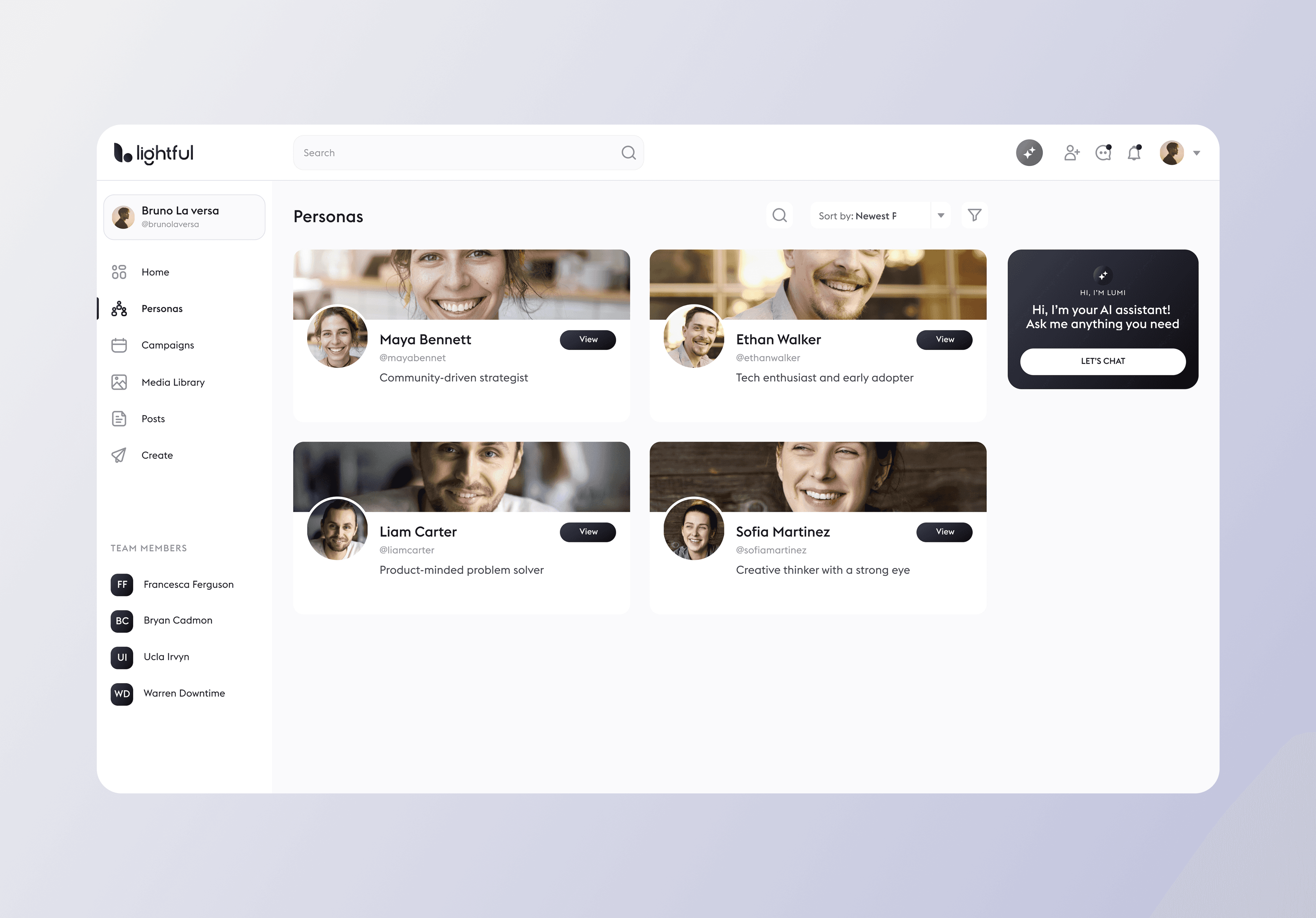
PERSONAS
Two users helped us make the problem tangible.

Rapid experimentation
We didn't know what the right AI product looked like yet.
So instead of spending months designing one answer, we built several.
Over a five-week sprint, our cross-functional squad created three high-fidelity prototypes and tested them directly with users.
We worked through daily stand-ups and weekly demos, using tools including v0, Bolt, Figma Make and Replit to move from idea to interactive prototype quickly.
Prototype 01
Turn organisational knowledge into a foundation for AI.
One concept helped organisations generate three foundational outputs: Programme Executive Summary Keystone Story Target Personas. Rather than repeatedly explaining their organisation to AI, users could establish context once and reuse it across future workflows.
Prototype 02
Help nonprofits create better content without starting from a blank page.
Another prototype explored task-specific content creation, including blog posts and donor emails. Instead of asking users to craft the perfect prompt, the experience framed AI around the communication task they were already trying to complete.
assumption
Then users proved some of our assumptions wrong.
What users told us changed the product.

redesign
Redesigning Lightful for trust, scale and market readiness.
There was another issue.
The product worked, but users didn't always perceive it as a mature AI product.
Feedback suggested that:
the experience felt functional rather than premium
users compared it with newer AI-native products
presentation directly affected trust and credibility
At the same time, Lightful was entering a period of strategic change and acquisition discussions.
So the challenge expanded.
We weren't only redesigning workflows.
We were redesigning how the product felt.
Trust is also a design problem.
The visual system became part of the product strategy. A more focused interface, stronger hierarchy and clearer interaction patterns helped position Lightful AI as a credible product rather than a collection of experimental AI tools.

The final product
Start with context.
Instead of beginning with an empty conversation, Lightful AI could help users establish an organisational foundation first.
The Keystone Story experience used information from an organisation's existing website and guided users through validating and refining the generated context.


One workspace. Multiple AI workflows.
The final experience brought several specialist tools together in one product:
Content Creator ✱ Image Creator ✱ Persona Creator ✱ Campaign Assistant ✱ Keystone Story Creator ✱ Fundraising Coach
Rather than asking users to understand the capabilities of an AI model, we organised the experience around the jobs they were already trying to accomplish.

Create with your organisation already in context.
Users could generate content while retaining the organisation's existing knowledge, rather than repeatedly prompting AI from scratch.


Reuse what the organisation already knows.
Generated personas, campaigns, stories and other assets became reusable context for future workflows. This created a compounding system:
create once → reuse context → generate something new
Users could move generated content into an editable workspace rather than treating AI output as final. This addressed one of the clearest signals from testing: people wanted AI to accelerate the work, not take ownership of it.


Connecting AI with the existing Lightful ecosystem.
The product could also bring existing personas and coaching experiences into AI workflows, connecting the company's established platform capabilities with the new AI experience.




the impact.
For the first time, Lightful could deliver expertise without requiring direct human involvement.
70%
reduction in content creation effort Measured by comparing manual creation time with AI-assisted workflows during beta testing and prototype evaluations.
2,000+
AI-generated assets created during beta
8/10
average user feedback score
60%
of beta users created more than one asset
45%
reused previously generated assets in new workflows
what I learned?
For the first time, Lightful could deliver expertise without requiring direct human involvement.
Start with the proprietary advantage.
AI itself wasn't the differentiator. Lightful's accumulated knowledge of the nonprofit sector was.
Prototype the uncertainty.
Working with AI meant many assumptions couldn't be validated through static design alone. Interactive prototypes let us learn faster and avoid committing too early.
Context is a product feature.
The more organisational context the system understood, the less work users had to do — and the more relevant the outputs became.
Design for collaboration, not replacement.
The strongest workflows weren't those where AI did everything. They were the ones where AI gave users a better starting point while keeping them in control.